01
Device discovery
Find and identify your own devices and services without memorising addresses.
Open networks. Direct connections. Practical engineering. Our goal is to make the potential of the end-to-end internet useful to everyday people.
IPv6 is usually introduced as the answer to IPv4 address scarcity. We believe its bigger opportunity is architectural: globally unique addresses make it practical for individual devices to participate more directly in the internet.
This does not make every device automatically reachable. Firewalls, network policies, changing addresses, authentication, and security remain important. But IPv6 removes many of the address-sharing constraints that shaped the NAT-heavy IPv4 era.
A new network deserves more than old applications with new addresses. It deserves applications designed around personal devices, direct communication, and user-controlled services.
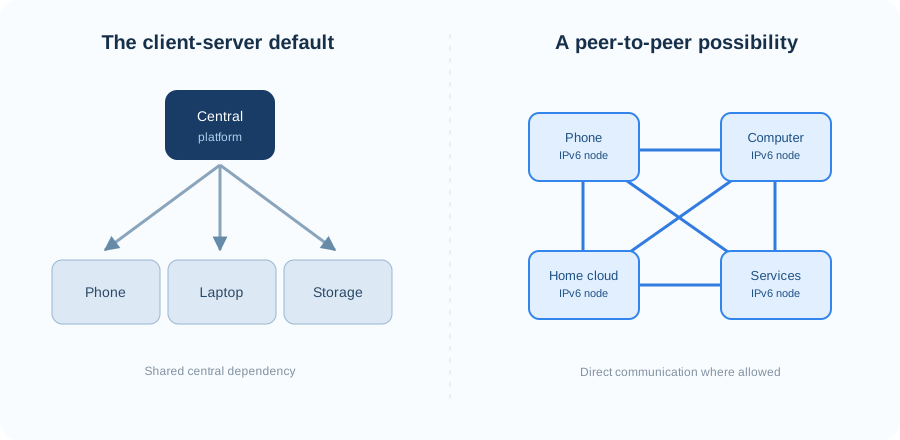
Conceptual models. Practical deployments will often blend IPv4, IPv6, public cloud services, and peer-to-peer connections.
When devices can participate directly, individuals need better tools for discovery, trust, permissions, and everyday management.
Find and identify your own devices and services without memorising addresses.
Know which device or user is requesting access, and why it should be trusted.
Establish encrypted paths with suitable security controls and connectivity fallbacks.
Manage storage, apps, backups, and permissions without becoming a systems administrator.
Principles inform our engineering choices—but we favour workable, verifiable systems over ideological purity.
Prefer direct encrypted data paths where possible, while using coordination services when they make connectivity practical.
Use established cryptographic protocols, appropriate access boundaries, and thoughtful device and service management.
Build on Linux, OpenWrt, WireGuard, and open standards, and contribute our own work when it may help others.
Measure what matters: latency, loss, congestion, routing, reconnection behaviour, and the quality of the actual user experience.
Minimise unnecessary data processing, define access carefully, and be transparent about what a system does and does not protect.
Our open-source WireGuard peer coordination protocol explores practical peer-to-peer connectivity in dynamic network environments.